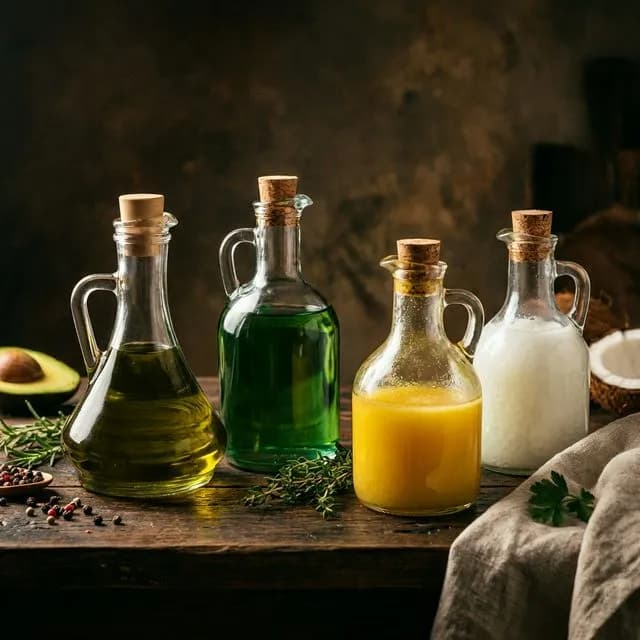
Healthy Cooking Oils Ranked:
A Science-Based Guide
Meaningful Diet Editorial
February 7, 2026 · 8 min read
Cooking oil is the foundation of nearly every meal you prepare. It's the ingredient you use most frequently, in the largest quantities, and it directly enters your body with every bite. Yet most kitchens default to whichever oil is cheapest, usually a highly refined industrial seed oil that may be doing more harm than good.
This guide ranks cooking oils by the three metrics that actually matter: fatty acid profile, smoke point, and oxidative stability. Understanding how these interact will change the way you cook.
The Three Things That Matter
Fatty Acid Profile
Fats are chains of carbon atoms bonded together. Saturated fats have all single bonds (very stable). Monounsaturated fats (MUFA) have one double bond (fairly stable). Polyunsaturated fats (PUFA) have multiple double bonds (fragile, prone to oxidation). The more double bonds, the more vulnerable the fat is to heat, light, and oxygen damage.
Smoke Point
The temperature at which oil begins to break down, releasing free radicals and toxic aldehydes. Cooking above an oil's smoke point damages the fat and produces harmful compounds. But smoke point is only part of the story, oxidative stability matters more.
Oxidative Stability
This is how resistant an oil is to forming harmful oxidation byproducts when heated. An Australian study published in Acta Scientific Nutritional Health found that extra virgin olive oil was actually the most oxidatively stable cooking oil, even more stable than oils with higher smoke points, thanks to its high antioxidant content.
The Tier List: Cooking Oils Ranked
🟢 Tier 1: Excellent Choices
Extra Virgin Olive Oil (EVOO)
Smoke Point: 375–405°F · Primarily MUFA (73% oleic acid) · Highest antioxidant content of any cooking oil
Best for: Sautéing, dressings, roasting, finishing. Despite the myth, EVOO is safe for most cooking, its antioxidant content gives it superior oxidative stability. Buy in dark glass, check harvest date.
Pure Avocado Oil
Smoke Point: 480–520°F · Primarily MUFA (70% oleic acid) · Neutral flavor
Best for: High-heat cooking, searing, deep frying, grilling. The highest smoke point of any healthy oil. Verify the brand is 100% pure, a UC Davis study found that 82% of avocado oils tested were mislabeled or rancid.
Grass-Fed Ghee
Smoke Point: 450–485°F · Saturated + MUFA · Contains butyrate, vitamins A, D, K2
Best for: High-heat cooking, Indian cuisine, searing, baking. The clarification process removes milk solids (and lactose), making it dairy-free and incredibly shelf-stable. Butyrate directly fuels gut lining cells.
Grass-Fed Butter
Smoke Point: 300–350°F · Saturated + MUFA · Rich in CLA, K2, butyrate
Best for: Low-medium heat cooking, baking, finishing. Lower smoke point than ghee, but contains conjugated linoleic acid (CLA), shown to reduce body fat in clinical trials. The rich flavor is irreplaceable in cooking.
🟡 Tier 2: Good in Specific Contexts
Virgin Coconut Oil
Smoke Point: 350°F · 92% saturated fat · High in MCTs (65%)
Best for: Baking, medium-heat cooking, curries. MCTs are metabolized as immediate fuel. Extremely oxidation-resistant. The coconut flavor limits versatility but is excellent when desired.
Tallow (Beef Fat)
Smoke Point: 400°F · Saturated + MUFA · Excellent heat stability
Best for: Frying, roasting, high-heat applications. Traditional cooking fat with excellent oxidative stability and a savory depth of flavor. McDonald's originally used beef tallow for their fries before switching to seed oils in 1990.
Sesame Oil (Toasted)
Smoke Point: 350–410°F · MUFA + PUFA · Contains sesamol (antioxidant)
Best for: Asian cuisine, finishing, low-heat stir-fry. The antioxidant sesamol provides surprising oxidative stability for an oil with a mixed fatty acid profile. Use sparingly as a finishing oil for maximum flavor impact.
🔴 Tier 3: Avoid
Canola Oil, Soybean Oil, Corn Oil, Sunflower Oil, Safflower Oil
All industrial seed oils with high PUFA content (often 50–70% polyunsaturated). They require extreme processing: solvent extraction with hexane, degumming, bleaching, and deodorizing. Despite high smoke points, they produce the highest levels of toxic aldehydes when heated, up to 20× more than olive oil in comparative studies.
Margarine and Vegetable Shortening
Industrially hydrogenated seed oils designed to mimic butter. Even "trans-fat-free" versions contain trace amounts of trans fats and interesterified fats, a newer industrial fat modification whose long-term health effects are poorly studied.
"Vegetable Oil" (generic blend)
Usually soybean oil or a blend of the cheapest seed oils available. The vague label is a red flag, quality oils proudly declare their source. This is the most common pro-inflammatory cooking fat in American kitchens.
The Bottom Line
Your cooking oil strategy can be simple: Extra virgin olive oil for most everyday cooking and dressings. Avocado oil or ghee when you need serious heat. Butter for flavor-forward dishes and baking. Coconut oil when the flavor works. A quick swap of your default cooking oil is one of the single highest-impact changes you can make for your health.
Eliminate all industrial seed oils. Your body will thank you by producing less inflammation, maintaining more stable blood sugar, and supporting a healthier gut microbiome.
Used by thousands · Always free
Ready to upgrade your kitchen fats? Start here.
Our AI Swap Tool is the internet's most popular free ingredient swap engine. Type any cooking oil or fat and instantly see the most nutrient-dense alternative available, complete with purchase links.
Use the Swap Tool →