Mastering the Glycemic Index
for All-Day Energy
Meaningful Diet Editorial
February 3, 2026 · 9 min read
That foggy, heavy feeling that hits around 3 PM is not a productivity problem or a sign you need more caffeine. It's a blood sugar crash, and it's almost entirely predictable and preventable once you understand one simple concept: the Glycemic Index.
TL;DR. The short version
- →The Glycemic Index (GI) ranks carbohydrates 0–100 based on how fast they raise your blood sugar. High-GI foods spike you fast; low-GI foods release glucose slowly.
- →Repeated blood sugar spikes lead to insulin resistance, the hidden mechanism behind chronic fatigue, weight gain, and eventually metabolic disease.
- →You don't have to eliminate carbs. You just need to "clothe" them, pair any carb with protein and fat to dramatically blunt its glycemic impact.
The Rollercoaster You Didn't Know You Were Riding
Picture it: it's 12:30 PM and you've just eaten a bowl of pasta, a bagel, or one of those "healthy" acai bowls that's actually loaded with fruit syrup. You feel a brief surge of energy. By 2:45 PM, you are borderline non-functional. Brain fog. Irritability. An overwhelming need to lie down or consume something sweet.
This is the blood sugar rollercoaster, and it plays out in the exact same biological sequence every time. High-GI carbohydrates digest rapidly and flood your bloodstream with glucose all at once. Your pancreas interprets this as an emergency and releases a large, fast surge of insulin to clear the glucose. The insulin works, maybe too well. Blood sugar drops sharply, often below your baseline fasting level. The result is the crash: fatigue, mental fog, cravings, and the irresistible pull toward whatever will give you the fastest glucose hit.
Then you eat something sugary or starchy. And the cycle repeats.
The Glycemic Index Scale
White bread, white rice, sugary cereals, standard pasta, fruit juice, instant oats
Whole wheat bread, sweet potato, raw honey, ripe banana, brown rice
Lentils, chickpeas, berries, quinoa, chickpea pasta, most non-starchy vegetables
How Chronic Spiking Becomes Insulin Resistance
The occasional sugar spike is not the problem. Our biology handles it just fine. The problem is doing this repeatedly, at every meal, for years. When your pancreas is forced to release high doses of insulin multiple times a day, your cells start downregulating their insulin receptors. They become desensitized to the signal, just like turning down the volume on a TV that's been blasting at full volume for years. This is Insulin Resistance.
Insulin resistance is not just a diabetes precursor. Because insulin is the body's primary fat-storage hormone, high chronic insulin levels make it biochemically very difficult to use stored body fat as fuel. You feel constantly hungry even when you've eaten enough. Weight accumulates and becomes stubborn. Energy stays perpetually low. And the path to Type 2 diabetes, fatty liver disease, and cardiovascular disease becomes much shorter.
“The 3 PM crash isn't a character flaw. It's your pancreas reacting to breakfast. The good news: it's almost entirely fixable with one shift in how you build your meals.”
The One Shift That Changes Everything: Clothing Your Carbs
Here is the most actionable thing in this entire article: you do not need to avoid carbohydrates entirely. You need to stop eating them naked.
Think of your stomach as a funnel. When you eat a carbohydrate alone, a bagel, a bowl of cereal, a handful of crackers, it flows through digestion quickly and hits your bloodstream in a fast rush. But when you combine that same carbohydrate with protein and a healthy fat, you slow everything down. The fat literally slows gastric emptying. The protein requires a complex breakdown process. The combined effect is that glucose trickles into your blood steadily over several hours instead of flooding in all at once. No spike. No crash.
3 High-Leverage Meal Swaps
1. The Breakfast Upgrade
Instead of
Sugary oat cereal with skim milk: this combination practically guarantees a 10 AM crash. The cereal is high GI, the skim milk adds negligible fat or fiber to slow it down.
Swap to
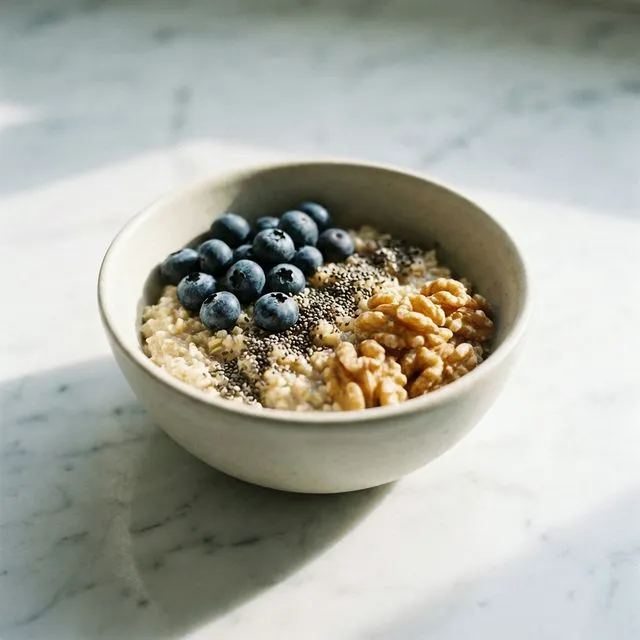
Full-fat Greek yogurt (20g+ protein) with chia seeds, a small handful of walnuts, and fresh raspberries. The fiber and healthy fat acts as a brake, and the protein triggers satiety hormones. Most people report staying full until 1 or 2 PM.
2. The Pasta Fix
Instead of
Traditional white flour pasta: processed from refined wheat, stripped of all its bran and fiber, it digests at roughly the same speed as white bread.
Swap to
Banza Chickpea Pasta or a red lentil pasta. They maintain the texture and experience you love while delivering dramatically more fiber and plant protein, pulling the GI score down from the 70s into the 40s. Always cook it al dente, the less cooked a pasta is, the lower its GI.
3. The Rice Rethink
Instead of
Jasmine or standard white rice on its own: among the highest GI staple foods available.
Swap to
Quinoa (a complete protein with all 9 essential amino acids) or cauliflower rice. Pro move: if you need white rice, cook it in bone broth, then cool it in the refrigerator overnight. Cooling rice converts some of the digestible starch into resistant starch, a form your small intestine cannot break down. This lowers its GI significantly and feeds your gut bacteria as a prebiotic fiber.
Ready to act on this?
Find the hidden sugar bombs in your grocery list.
Our free AI Swap Tool analyzes any ingredient or food and returns lower-GI, nutrient-dense alternatives instantly. No signup required.
Use the Swap Tool →